
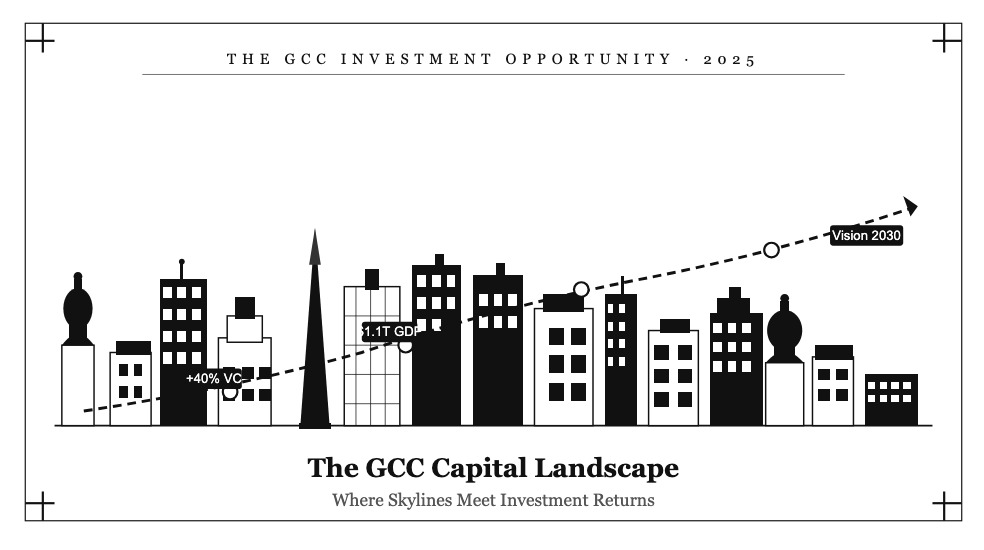
How entrepreneurs across Saudi Arabia, the UAE, and the wider Gulf are using proven franchise models to build multi-unit empires — without reinventing the wheel.
There is a quiet revolution happening across the shopping malls of Riyadh, the waterfront promenades of Dubai, and the gleaming new districts of Doha. Franchising has become the GCC's most powerful vehicle for entrepreneurial wealth creation — and the entrepreneurs who recognise this are building portfolios of business units that compound income, attract institutional investors, and scale across borders with remarkable speed.
The Gulf's economic profile creates an almost ideal environment for franchise growth. High consumer spending power, a young and brand-conscious population, rapid urban expansion, and governments actively incentivising private sector development all combine to create extraordinary demand for quality products and services delivered at scale.
But it is the franchise model's specific characteristics that make it particularly well-suited to this market. In a region where regulatory navigation, supply chain management, and brand-building from scratch carry significant risk and cost, franchising offers entrepreneurs something uniquely valuable: a proven system backed by an established brand, with built-in operational support and a tested path to profitability.
75% of GCC franchise units are profitable within 24 months
3,500+ international franchise brands operating in the region
18% annual growth rate of GCC franchise sector
UAE #1 most active franchise market in MENA
For the entrepreneur weighing their options, it is worth understanding what franchise ownership actually offers relative to building something from scratch:
Factor | Independent Startup | Franchise Ownership |
|---|---|---|
Brand Recognition | Build from zero (3–7 years) | ✓ Instant established brand |
Operational Playbook | Trial and error | ✓ Tested systems & training |
Investor Appeal | High risk, uncertain metrics | ✓ Bankable, comparable data |
Creative Freedom | ✓ Complete control | Limited by brand standards |
Time to Revenue | 12–36 months typically | ✓ Often 3–9 months |
Scalability | Dependent on personal innovation | ✓ Replicable unit economics |
Failure Rate (5yr) | ~60% fail within 5 years | ✓ ~15% fail within 5 years |
Not all franchise categories perform equally in the Gulf. Understanding where consumer demand, government spending, and demographic trends intersect is essential for choosing the right brand to invest in:
QSR and casual dining dominate, with particular strength in coffee, artisan bakeries, and halal-certified international chains.
↑ 22% YoY
Government health mandates and a young, affluent population are driving extraordinary demand for boutique fitness and wellness franchises.
↑ 31% YoY
High birth rates, expat populations, and rising educational standards create a massive market for premium education franchises.
↑ 27% YoY
Saudi giga-projects, Expo legacies, and Gulf tourism ambitions are creating unprecedented demand for branded hospitality concepts.
↑ 35% YoY
IT, cybersecurity, and digital transformation services are the fastest-emerging franchise categories as Gulf businesses digitise rapidly.
↑ 40% YoY
GCC consumers spend among the highest in the world on personal care. Franchise salons, spas, and grooming concepts are thriving.
↑ 24% YoY
Franchising in the GCC is not about importing a Western business model — it is about deploying a proven operational system in one of the world's most high-velocity consumer markets. The entrepreneurs who understand this distinction build empires.
— MENA Franchise Association, 2024 Outlook Report
One of the most underappreciated aspects of franchise ownership is its investability. Unlike a startup with uncertain unit economics and unproven product-market fit, a franchise operates with measurable, comparable, and historically validated financial metrics. This makes it dramatically easier to attract investment capital — a critical advantage in a region where the competition for institutional capital is intense.
Banks across the GCC are increasingly willing to finance franchise acquisitions, recognising the lower risk profile relative to independent businesses. Saudi Arabia's Kafalah programme, the UAE's Khalifa Fund, and Bahrain's Tamkeen are all specifically structured to support franchise entrepreneurs. Meanwhile, family offices looking for risk-adjusted returns in the consumer sector regularly acquire minority positions in multi-unit franchise portfolios.
Before approaching any investor for franchise capital, ensure you have: the Franchise Disclosure Document reviewed by a GCC-qualified lawyer, independently verified unit economics from existing franchisees in comparable markets, a territory agreement that protects your exclusivity, and a clear understanding of the repatriation rules for royalties in each GCC country you plan to operate in.
Franchise fees in the GCC range from $20,000 for smaller local brands to $500,000+ for premium international concepts. Understanding your available capital — and your appetite for leverage — determines which tier of franchise is right for you.
Each GCC country has distinct regulatory environments, consumer profiles, and competitive landscapes. The UAE offers the easiest market entry; Saudi Arabia offers the largest market size. Qatar and Kuwait offer premium consumer segments with less competition.
Not every internationally successful brand translates to the Gulf. Assess halal certification requirements, cultural alignment, price-point suitability, and whether the brand has existing proven performance in comparable Muslim-majority markets.
In a region growing this fast, territorial exclusivity is everything. Negotiate master franchise rights across multiple countries or city clusters wherever possible — the value of territorial rights in the GCC has been consistently underpriced and then rapidly appreciated.
The franchisor provides the system; you must provide the local execution capability. Invest in a strong operations manager, establish supplier relationships, and identify a local partner or government relations advisor who knows your target market deeply.
The greatest franchisees in the GCC are those who treat their first unit as proof-of-concept and immediately begin planning units two through ten. Institutional investors pay premium multiples for well-managed multi-unit franchise portfolios with consistent performance across locations.
The most financially sophisticated franchise entrepreneurs in the GCC rarely think in terms of single units. They think in terms of portfolios. A single coffee franchise unit might generate $120,000 in annual profit. But ten units across two GCC markets, managed by a central operations team, generate not just $1.2 million in profit — they generate an asset portfolio that a strategic investor or sovereign fund can value at 5–8x EBITDA. That is an enterprise worth $6–10 million, built in 4–6 years from a single initial investment.
This is the compounding logic of franchise ownership in the GCC — and it is why the region's most successful entrepreneur-investors have increasingly moved from building startups to building franchise empires. The risk is lower, the returns are comparable, and the exit opportunities — to strategic buyers, private equity, and even public markets — are significantly more accessible.
"
The question is not whether franchising is a legitimate path to entrepreneurial wealth. In the GCC in 2025, it may be the most reliable one available. The question is whether you have the discipline to execute a proven system better than anyone else in your territory.
— GCC Franchise Investors Forum, Dubai 2024
If you are reading this in Riyadh, Dubai, Doha, Kuwait City, Muscat, or Manama, you have something that every international entrepreneur entering this market is desperately seeking: you are already here. You understand the culture, speak the language, have existing relationships, and can navigate the regulatory environment with instincts that no consultant can replicate.
That local advantage — combined with the operational leverage of a proven franchise system and the capital availability of one of the world's richest investment regions — creates a genuinely unique entrepreneurial opportunity. The question is not whether the conditions are right. They are. The question is whether you will move fast enough to capture the territory before someone else does.
The highest-value franchise territories are being acquired right now. Get the intelligence you need to act first.
